.png?width=259&name=WSAI%20Amsterdam%20Orange%20no%20dates%202000x300%20(1).png)
.png?width=263&name=IM_Mothership_assets_LOGO_MINT%20(2).png)

AI is already making familiar work faster. The bigger opportunity is using it to find answers that teams would not have known to look for in the first place.
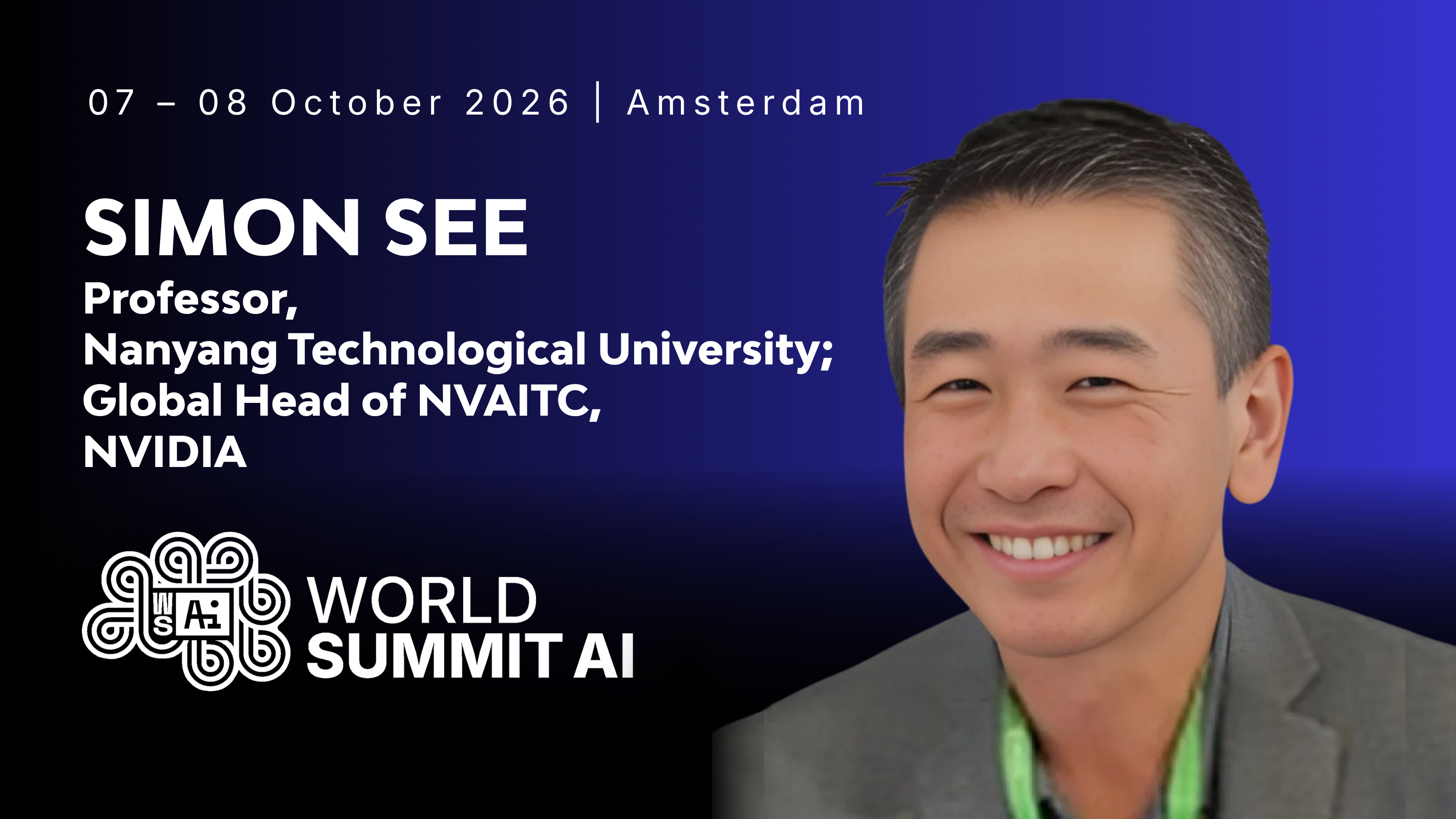
That is the shift Professor Simon See, Global Head of the NVIDIA AI Technology Center and Professor at Nanyang Technological University, sees taking place across science, engineering and industry. AI is being combined with simulation, scientific data and human expertise to explore more options before a molecule is tested, a material is manufactured or a product becomes a physical prototype.
“AI has been actually good in automations,” says Simon, whose work spans high-performance computing, AI, computational science and a global network of research centres working with universities and government laboratories. “But more importantly, now we are developing AI algorithms and ideas on how to discover new things, new materials, new science.”
For leaders, the question is no longer just where AI can remove effort. It is whether they can build an R&D system in which data, models, simulations, experiments and domain experts continuously improve one another.
From AI automation to AI discovery
.png?width=3840&height=2160&name=Simon%20See%20(2).png)
Automation starts with a relatively defined task: take process A to outcome B, but do it more quickly, consistently or at greater scale. Discovery starts with a more open question.
“It’s not just automation where you say, ‘I’m going to do A to B in a very quick form,’” Simon says. “But now I’m asking the AI to say, ‘With this data, what have you discovered? What can you help me to find out?’”
Scientific and engineering problems are rarely linear workflows. The number of possible molecular structures, material combinations or product-design variables can be enormous. Simulation gives teams a way to test hypotheses computationally; AI can help search that space more intelligently, predict useful properties and prioritise the options most worth taking into the lab or factory.
Protein science shows the scale of the opportunity. AlphaFold, developed by Google DeepMind, predicts 3D protein structures from amino-acid sequences, and its database now contains more than 200 million predicted structures. It does not replace experimental biology, but it provides a much richer starting point for biological research and experimental design.
The point is not an autonomous science machine that removes people from the process. It is a more capable loop: human judgement frames the problem, AI and simulation explore options at scale, real-world experiments test them, and the resulting evidence improves the next cycle.
How AI and simulation improve drug discovery
.png?width=974&height=406&name=AI-Powered%20R%26D%20How%20Simulation%20Is%20Moving%20AI%20Beyond%20Automation%20(1).png)
Drug discovery is a powerful example of where this approach can create value. Traditional discovery involves extensive trial and error: identifying a target, selecting or designing compounds, assessing their behaviour and progressing the candidates that look most promising. It is slow, expensive and uncertain.
“What we have right now is artificial intelligence that’s able to do all the various complex simulations… in a quick time,” Simon says. “Previously you did trial and error: you took a compound, you tried it, you tested it and you did a simulation. Now you could ask the artificial intelligence… to try all sorts of combinations and then figure out [which] compound fits this particular characteristic.”
In practice, the near-term promise is better prioritisation. AI can help researchers focus finite lab capacity on a more informed shortlist: molecules that appear more likely to interact with a target, meet key design constraints or deserve further investigation. It can narrow the search space; it cannot remove the need for laboratory evidence, clinical trials or regulatory scrutiny.
That distinction matters. The US Food and Drug Administration (FDA) recognises growing use of AI across drug development but recommends a risk-based assessment of whether a model is credible for its specific use. Its guidance highlights multidisciplinary expertise, data governance, risk-based performance assessment and life-cycle management.
AI materials design: from prototypes to possibilities
The same model applies far beyond life sciences. Simon uses a familiar product example: a shoe.
Instead of beginning with a sketch, a 3D CAD model and repeated physical prototypes, a designer could specify what the product must do: a soft base, a target lifespan, resistance to particular stresses and other performance requirements. “Automatically the artificial intelligence will then, by looking at the data, try all sorts of simulation and produce you the type of design that fits,” Simon says.
The important shift is from generation to engineering. AI can widen the option set and accelerate iteration; people still decide what good looks like, set the constraints and weigh the trade-offs between performance, cost, manufacturability, aesthetics and sustainability.
That approach is already moving beyond theory. A Nature Communications study used AI to generate polymer-membrane candidates for carbon capture, then tested their performance through molecular-dynamics simulation under realistic conditions. The findings broadly aligned with the model’s predictions, illustrating the loop Simon describes: AI explores options, while simulation helps validate them before they reach the real world.
Why compute is now R&D infrastructure
This discovery model depends on access to serious computing capacity. Simon’s analogy is simple: “A scientist used to be a biological scientist. The most important thing is the microscope… [it] allows them to look into cells. Now, with AI itself, the GPU has become the tool for the engineers and the scientists.”
That does not mean every organisation must own a supercomputer. It does mean leaders should treat compute as a strategic R&D input, not a back-office IT detail. Without reliable access to GPUs or other relevant computing infrastructure, teams cannot train, adapt or run the models and simulations needed to explore complex design spaces at useful speed.
The more important question is whether that compute is connected to the work that matters: the right data, simulation environments, experimental systems and domain teams. A powerful model isolated from these ingredients is unlikely to produce a durable discovery advantage.
Build a closed-loop AI R&D system
When asked what a strong AI-enabled R&D system should look like, Simon resists a simplistic blueprint. “I don’t think we have a perfect answer right now,” he says. “A lot of these things we’re still learning and experimenting with.”
But its components are clear. “We need to connect the data… to the simulation,” he explains. “We also need the AI models to be able to access the data and the simulation.” The system must learn from its failures too: “We need to learn from our mistakes… [so] the AI [is] able to learn from it and then not repeat the mistakes, or learn from the mistakes to make new decisions.”
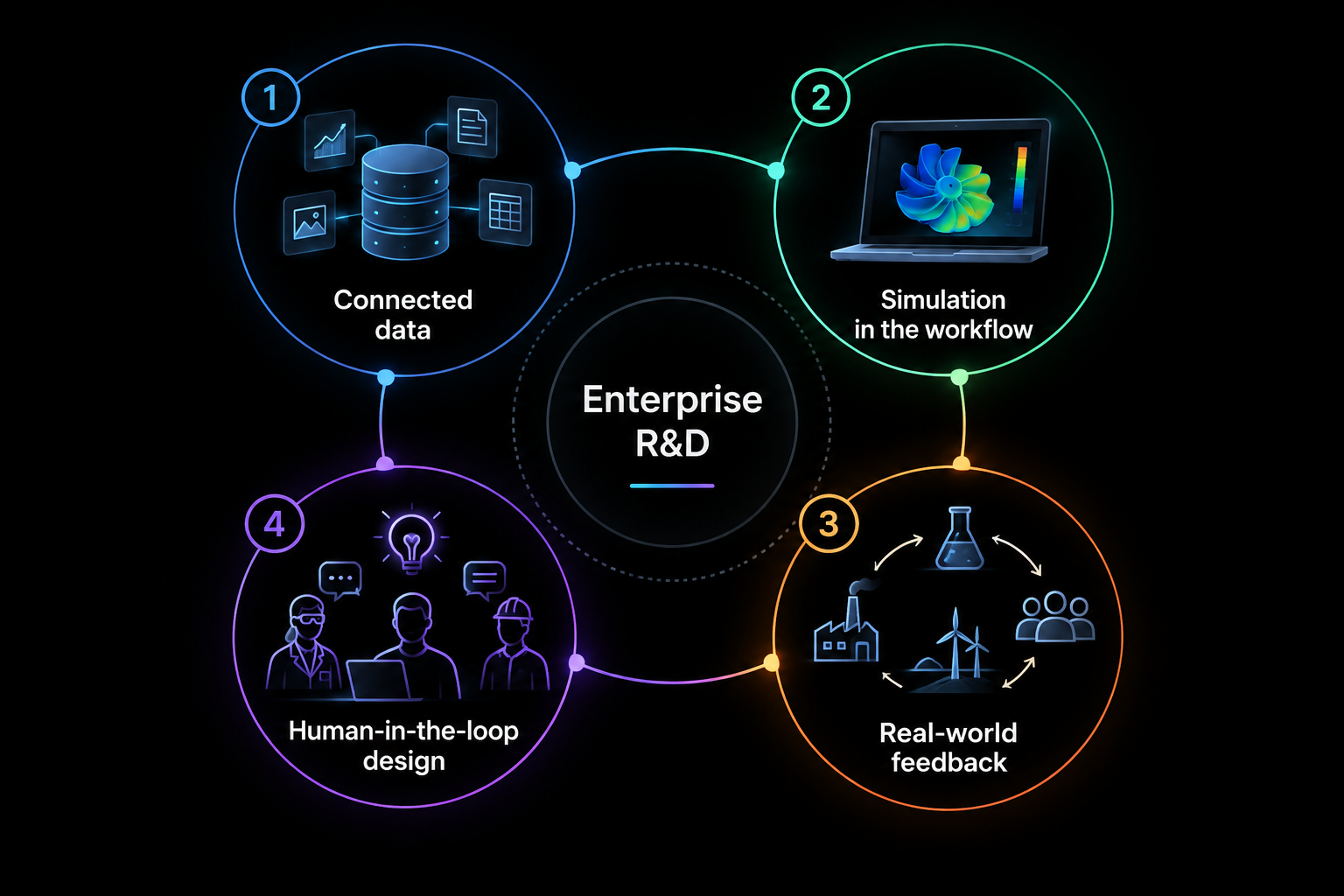
For an enterprise R&D leader, that translates into four connected capabilities:
- Connected data: Make relevant experimental, operational and design data accessible, governed and usable by the teams and models doing the work.
- Simulation in the workflow: Test options computationally before committing scarce time, materials or physical prototypes.
- Real-world feedback: Bring observations from the lab, factory, field or customer environment back into model development and decision-making.
- Human-in-the-loop design: Involve scientists, engineers and operators in defining the problem, assessing outputs and shaping the workflow from the start.
Companies often over-focus on one layer. “They say, ‘Okay, we need to have better AI models,’” Simon says, “forgetting about how to connect the data, the simulation, and also… how to gradually get the scientists and the engineers to be familiar with the tools.”
Buying a better model is not the same as building a better R&D system.
Put domain experts in the loop
The gap between technical teams and domain experts is where promising AI projects often lose traction. Computer scientists may build systems without fully understanding the practical workflow, constraints or decision-making of biologists, materials scientists or engineers. Domain experts, meanwhile, may not know what the technology can realistically do or how it was designed.
“We need to actually link them up very closely together,” Simon says. “When we design a system, we make sure that they are in the loop to understand how the system is being designed [and] whether it fits how they actually work.”
This is not a soft change-management point; it is a performance requirement. The FDA’s principles for AI in drug development likewise identify multidisciplinary expertise, a clear context of use, data governance and life-cycle management as core considerations.
The organisations most likely to gain an advantage will make cross-functional collaboration part of the design process, rather than hand a finished tool to scientists and engineers and hope adoption follows.
Validate AI in the real world
A simulation is not reality, and an AI output is not reliable simply because it is sophisticated.
“AI is not perfect,” Simon says. “There [are] bound to be errors.” The answer is an iterative validation process: “We need to build it, run through an experiment, and then… bring it to the real-life environment to see whether the results actually fit what the real-life environment is, and then bring the result back [as] feedback and retrain the AI algorithms.”
Trust should therefore be designed around the decision and the consequences of getting it wrong. Organisations need application-specific benchmarks: which measures of accuracy, error, robustness and safety are acceptable before a system can recommend, assist or operate with greater autonomy?
For an industrial system, evidence might include performance across different operating conditions, failure-mode testing, comparison with established engineering models and a monitored pilot in a live environment. For a scientific application, it may mean independent experimental replication. The principle is the same: validate in the context in which the system will actually be used.
Start early, but build guardrails as you learn
For leaders at the beginning of this journey, Simon’s advice is pragmatic: “Do not wait. We need to fail as early as possible.”
He is not advocating unbounded deployment. He is arguing for controlled, well-instrumented experiments early enough to expose where value and failure modes actually sit. “Get the project going, experiment with it, let it fail… learn from it, and then restart the project from a different angle if the earlier ones fail,” he says.
That advice lands amid a renewed and highly topical debate about whether the frontier of AI capability itself needs to slow down. In recent days, Anthropic chief executive Dario Amodei has called for companies to pace advances in frontier-model capabilities, arguing that the industry needs more time for safety testing, independent evaluation and safeguards to catch up. His proposal has put the relationship between innovation, control and competitive pressure back at the centre of the AI conversation.
Simon’s view is not that progress will simply pause. “AI is going to surge forwards, period,” he says. But he makes an important distinction between letting technology move and deploying it without understanding its limits. “We take the technology, experiment, we learn it, and then we build guardrails around it to see… where are the things [that] will fail… before we actually do the implementation.”
For enterprise R&D, this is the practical middle ground. Do not wait for a perfect model or a settled technology stack; the pace of change makes that a losing strategy. But do not mistake speed for readiness either. Build the evidence, testing and escalation routes around the specific system and setting in which it will operate.
Simon also raises a further challenge. If AI capability advances faster than people can assess it, “we may need to… build a system that actually AI-assists the regulator and also people who are building guardrails”. That is a provocative but logical extension of the closed-loop model: use AI not only to accelerate discovery, but to help monitor, test and govern the systems being deployed.
The next frontier is a learning system
The next AI advantage will not be found solely in automating today’s workflows. It will come from building learning systems that connect human expertise, compute, simulation and real-world evidence — systems that improve because they are designed to identify their own failures.
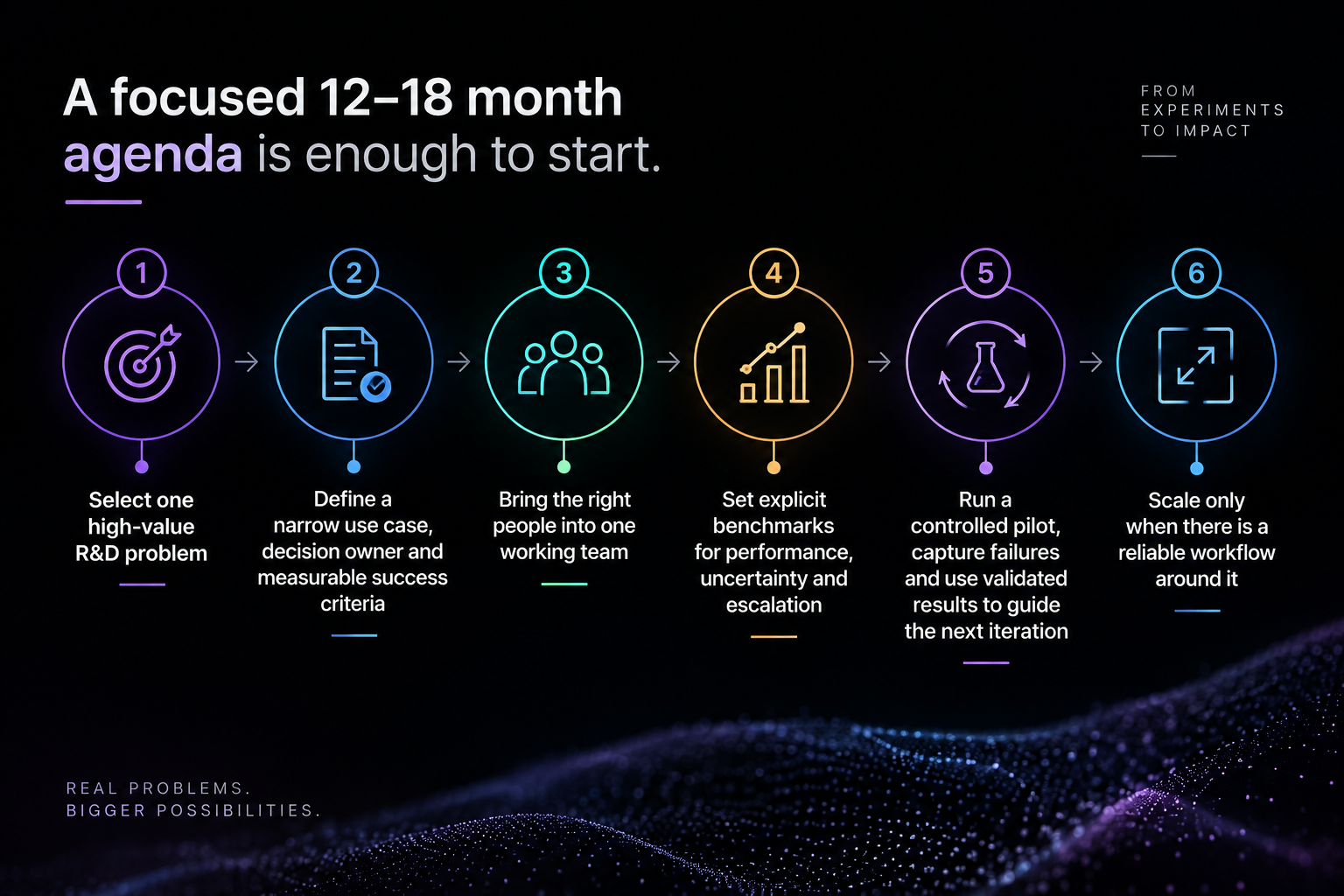
A focused 12–18 month agenda is enough to start:
- Select one high-value R&D problem where simulation, data and experimental feedback can be connected.
- Define a narrow use case, decision owner and measurable success criteria before choosing the model.
- Bring AI specialists, domain scientists or engineers, data owners and risk or quality leads into one working team.
- Set explicit benchmarks for performance, uncertainty and escalation to human review.
- Run a controlled pilot, capture failures and use validated results to guide the next iteration.
- Scale only when the organisation can show not merely model performance, but a reliable workflow around it.
Professor Simon See will join World Summit AI in Amsterdam on 7–8 October 2026. Join the conversation on the future of AI, science and industry at World Summit AI.
InspiredMinds! Community Hub
Inside the InspiredMinds! Community Hub, you’ll find deeper insights, expert perspectives, and practical discussions from the people building and deploying AI across Europe and beyond.

Join our regular LinkedIn newsletter - Global AI Dispatch!
World Summit AI global Summit series
5 – 9 October 2026
Amsterdam, Netherlands
World Summit AI Qatar
World Summit AI Canada
World Summit AI USA