---
title: "Europe’s AI Advantage: Turning Sovereignty and Regulation into an Edge"
description: "Over the last decade, most global companies have behaved as if there was one internet and one AI infrastructure. That assumption is breaking.
Governments from Brussels to Brasília are moving fast to build what they now call “sovereign AI”: domestic control over the compute, data and models they see as critical to economic resilience and national security. Nvidia’s Jensen Huang put it starkly when discussing sovereign AI: every country, he said, will “need to own the production of their own intelligence.”"
image: https://blog.worldsummit.ai/hubfs/geralt-globe-895580_1920.jpg
---
[BOOK NOW](http://worldsummit.ai/tickets/)
.png?width=259&name=WSAI%20Amsterdam%20Orange%20no%20dates%202000x300%20(1).png)
.png?width=263&name=IM_Mothership_assets_LOGO_MINT%20(2).png)
[BOOK NOW](http://worldsummit.ai/tickets/)
# Europe’s AI Advantage: Turning Sovereignty and Regulation into an Edge
Posted by [World Summit AI](https://blog.worldsummit.ai/author/world-summit-ai) on Apr 16, 2026 11:45:00 AM

- [Tweet](https://twitter.com/share)
For years, Europe has been cast as the world’s AI referee: strong on rules, light on hyperscalers. That story is only half‑true now.
Europe is trying to turn itself into an ‘AI continent’ with new AI factories, supercomputers and investment tools, even as the AI Act and data‑sovereignty rules make it one of the hardest places to deploy at scale. For corporate leaders and big‑tech execs, that tension is exactly why Europe is the right place to design a sovereign‑ready AI operating model.
European Commission President Ursula von der Leyen has been blunt about the ambition: “I want the [future of AI](https://www.itpro.com/technology/artificial-intelligence/will-the-future-of-ai-be-made-in-europe-the-eu-thinks-so) to be made in Europe,” she said when outlining the bloc’s AI strategy, promising an “AI‑first” approach across sectors “from robotics to healthcare, energy and automotive.” Former Internal Market Commissioner Thierry Breton went further, calling the [EU AI Act](https://www.cio.com/article/2098751/ways-it-leaders-can-meet-the-eu-ai-act-head-on.html) “a launchpad” that can make Europe “the best place in the world for trustworthy AI.” The question for companies is whether they treat that mix of ambition and constraint as a compliance headache – or as a chance to get ahead of how AI will be governed everywhere.
At [World Summit AI](https://worldsummit.ai/), this is exactly what the [Sovereign AI Forum stage](https://worldsummit.ai/sovereign-ai-track/) and sessions like “Europe’s AI Advantage” are set up to explore: how Europe’s mix of regulation, industrial depth and sovereignty This is whyis reshaping the choices corporate and infrastructure leaders have to make about where their intelligence actually runs.
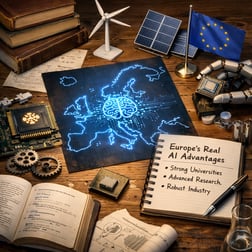
### **Europe’s real AI advantages**
Strip away the noise and three strengths stand out.
First, Europe still has deep industrial and scientific foundations in exactly the sectors AI is about to transform: manufacturing, energy, automotive, healthcare, finance. McKinsey and others estimate that [AI‑driven productivity](https://www.mckinsey.com/industries/technology-media-and-telecommunications/our-insights/accelerating-europes-ai-adoption-the-role-of-sovereign-ai) gains in these areas could be decisive for Europe’s competitiveness and for cushioning demographic and political pressures.
Second, Europe has become a global rule‑setter. The EU AI Act, alongside GDPR‑style data laws, is shaping how AI risk, transparency and governance will be handled well beyond its borders. For boards, that means AI programmes that can pass European scrutiny are likely to travel well in other regulated markets.
Third, Europe’s push on sovereignty is forcing new infrastructure models. EU‑backed AI factories and supercomputing projects, as well as private offerings like Europe‑only AI clouds, are early examples of region‑first stacks that blend access to frontier tools with tighter local control.
This has been described as Europe’s “[AI paradox](https://www.consultancy.uk/news/42220/europe-seeking-greater-ai-sovereignty-amid-geopolitical-friction)”: leaders know they must accelerate AI to drive growth, but because most of the stack still comes from outside the region, they also see it as a strategic risk. A sovereign AI approach, they argue, can “help resolve this challenge” by letting organisations “protect critical operations without hampering innovation and competitiveness.”
### **Where the constraints bite**
None of this is free.
Energy costs and grid constraints in parts of Europe make large‑scale AI infrastructure more expensive than in the US or Gulf. Data‑centre electricity demand in Europe is expected to almost double by 2030, turning power into a primary bottleneck for AI growth. As one World Economic Forum analysis puts it, [data centres](https://www.weforum.org/stories/2026/03/data-centre-energy-demand-strategic-asset/) are no longer “just real‑estate assets” but “essential national energy infrastructure” and a geopolitical issue in their own right.
On the regulatory side, the AI Act brings clarity but also complexity. Its risk‑based framework will force in‑scope firms to stand up governance, risk and compliance structures that go well beyond classic privacy programmes. Carme Artigas, one of the lead negotiators and a regular voice on AI governance, has called the [AI Act](https://mspglobal.com/blog/carme-artigas-what-the-eu-ai-act-means-for-msps-and-tech-leaders/) “a historic achievement,” stressing that the EU has tried to keep a “delicate balance: boosting innovation and uptake of AI across Europe whilst fully respecting the fundamental rights of our citizens.” For boards, that “delicate balance” is now a concrete governance task.
Corporate governance specialists are already advising boards to create dedicated AI committees, formal ethics policies and more robust risk reporting to meet their obligations. Leading governance and legal commentators now describe the EU AI Act as “the global benchmark” for AI regulation and warn that it will force companies to build new internal “governance, compliance and assurance capabilities” if they want to keep deploying at scale.
Finally, Europe still loses significant AI talent and capital to better‑funded ecosystems. Analysts warn that without reforms to capital markets, energy pricing and industrial policy, Europe risks designing the rules while others build the platforms.
### **How corporate leaders can use Europe as a lab**
For corporate and big‑tech leaders, the move now is not to wait for every implementing act to land, but to use Europe as a controlled environment to build the capabilities that will be essential anywhere AI is politically sensitive. Three moves stand out.
- **Design a Europe‑first architecture pattern**
- - Treat the EU as a region‑first stack: AI models and key workloads running in European data centres, fronted by an EU‑specific governance and logging layer, with clear boundaries to global services.
- Use that architecture to pilot the patterns we outlined in our previous [blog ](https://blog.worldsummit.ai/the-sovereign-ai-stack-what-it-means-for-your-global-architecture)in this series – a global core with a sovereign European edge, or a full EU stack for your most regulated lines of business.
- Look to the kinds of deployments being discussed on the Sovereign AI stage at WSAI – national partner clouds, EU‑only AI factories, sector‑specific sovereign zones – as concrete templates rather than thought experiments.
- **Pilot AI governance and safety in your toughest market**
- - Stand up an AI governance model that assumes AI Act‑level scrutiny: inventory of high‑risk systems, documented risk assessments, human‑in‑the‑loop controls, and clear board‑level oversight.
- Use European operations to test how these controls actually work in practice, then export the successful elements to other regions before similar rules arrive there.
- Sessions at WSAI on “Consent in an Age of Ambient Intelligence” and “Safe, Sound and Supervised” are perfect places to pressure‑test those governance ideas with peers who are already implementing them.
- **Align infrastructure and energy strategy with EU realities**
- When you place data centres and AI workloads in and around the EU, explicitly factor in energy availability, grid constraints and sustainability rules – not just latency and land price.
- Explore partnerships with providers and municipalities that can turn AI‑driven energy demand into a political asset (for example, by using waste heat for district heating), which can make your infrastructure projects easier to approve.
### **What this looks like from the boardroom**
For boards and C‑suites, Europe is not just another region on the map; it is the place where corporate competition, geopolitics and responsible AI all collide. Carnegie Europe warns that “state and corporate competition” in [frontier AI](https://carnegieendowment.org/europe/strategic-europe/2024/01/how-the-eu-can-navigate-the-geopolitics-of-ai) now risks undercutting safety and governance efforts unless Europe can steer both governments and firms toward responsible practice.
That is why governance advisers are telling European boards to move AI out of the “innovation” bucket and into core risk and strategy discussions. As Odgers Berndtson notes in its guidance on the EU AI Act, there will be ‘noticeable demand for board and C‑suite leaders who can establish a moral framework through which to navigate AI’ and who understand the regulation’s implications for liability and oversight.”
If you are a global leader, Europe gives you a forcing function. Here you will have to answer questions like:
- Where exactly do our high‑risk AI systems run, and what evidence do we have that they meet European standards?
- How do we reconcile our dependence on non‑European providers with calls for digital sovereignty from regulators and customers?
- Are we content to treat sovereignty as a compliance cost, or do we want to co‑shape new European infrastructure and governance models that align with our strategy?
### **From “AI referee” to strategic partner**
The easy story is that Europe will regulate while others innovate. The more interesting reality is that Europe is trying to use regulation, industrial strengths and sovereignty initiatives as leverage in a much wider contest over who controls the AI stack.
For corporate leaders and big‑tech firms, the opportunity is to meet Europe halfway: to treat the continent as the place where you work out how to run AI under the toughest mix of rules, energy and sovereignty constraints, then use that as your template elsewhere.
As a recent Tony Blair Institute paper on [Europe’s AI future](https://institute.global/insights/tech-and-digitalisation/sovereignty-in-the-age-of-ai-strategic-choices-structural-dependencies) puts it, the choice now is “whether to adapt to changes made elsewhere or to lead in shaping the rules and infrastructure of the AI age.” The same is true for companies operating here. Those that lean into Europe’s constraints and advantages now will be best placed to shape, not just survive, the next phase of the AI race.
**What do you think?**
Is Europe building a competitive advantage through regulation, or holding itself back? Join the conversation below and share your perspective in the comments.
If this is something you’re actively navigating, the conversation doesn’t stop here.
Inside the **InspiredMinds! Community Hub**, you’ll find deeper insights, expert perspectives, and practical discussions from the people building and deploying AI across Europe and beyond.
[Explore the Hub, access exclusive content, and stay connected to the conversations shaping what comes next.](https://worldsummit.ai/inspired-minds-membership/)
### World Summit AI global Summit series
[**World Summit AI 2026**
7 – 8 October 2026
Amsterdam, Netherlands
](http://qatar.worldsummit.ai/)[>> worldsummit.ai](https://worldsummit.ai/)
**World Summit AI Qatar **
[>> qatar.worldsummit.ai](https://qatar.worldsummit.ai/)
**World Summit AI Canada **
[>> americas.worldsummit.ai](https://americas.worldsummit.ai/)
**World Summit AI USA **
[>> usa.worldsummit.ai](https://usa.worldsummit.ai/)
Topics: [World Summit AI](https://blog.worldsummit.ai/tag/world-summit-ai), [Sovereign AI](https://blog.worldsummit.ai/tag/sovereign-ai), [InspiredMinds!](https://blog.worldsummit.ai/tag/inspiredminds), [InspiredMinds! Community Hub](https://blog.worldsummit.ai/tag/inspiredminds-community-hub)
## Featured posts
### Posts by Tag
- [AI (168)](https://blog.worldsummit.ai/tag/ai)
- [Interview (64)](https://blog.worldsummit.ai/tag/interview)
- [AIbrains (27)](https://blog.worldsummit.ai/tag/aibrains)
- [AI ethics (20)](https://blog.worldsummit.ai/tag/ai-ethics)
- [Machine Learning (13)](https://blog.worldsummit.ai/tag/machine-learning)
- [Responsible AI (12)](https://blog.worldsummit.ai/tag/responsible-ai)
- [World Summit AI (12)](https://blog.worldsummit.ai/tag/world-summit-ai)
- [Announcement (10)](https://blog.worldsummit.ai/tag/announcement)
- [AI Platforms (9)](https://blog.worldsummit.ai/tag/ai-platforms)
- [Press Release (9)](https://blog.worldsummit.ai/tag/press-release)
- [Data (7)](https://blog.worldsummit.ai/tag/data)
- [HealthTech (7)](https://blog.worldsummit.ai/tag/healthtech)
- [InspiredMinds! (7)](https://blog.worldsummit.ai/tag/inspiredminds)
- [InspiredMinds! Community Hub (7)](https://blog.worldsummit.ai/tag/inspiredminds-community-hub)
- [Business (6)](https://blog.worldsummit.ai/tag/business)
- [Digital Health (6)](https://blog.worldsummit.ai/tag/digital-health)
- [Sovereign AI (6)](https://blog.worldsummit.ai/tag/sovereign-ai)
- [COVID-19 (5)](https://blog.worldsummit.ai/tag/covid-19)
- [Conversational AI (5)](https://blog.worldsummit.ai/tag/conversational-ai)
- [Startups (5)](https://blog.worldsummit.ai/tag/startups)
- [Bias (4)](https://blog.worldsummit.ai/tag/bias)
- [Enterprise AI (4)](https://blog.worldsummit.ai/tag/enterprise-ai)
- [Ethics (4)](https://blog.worldsummit.ai/tag/ethics)
- [Medicine (4)](https://blog.worldsummit.ai/tag/medicine)
- [AI For Earth (3)](https://blog.worldsummit.ai/tag/ai-for-earth)
- [AI Workforce (3)](https://blog.worldsummit.ai/tag/ai-workforce)
- [Built environment (3)](https://blog.worldsummit.ai/tag/built-environment)
- [Climate (3)](https://blog.worldsummit.ai/tag/climate)
- [Data Science (3)](https://blog.worldsummit.ai/tag/data-science)
- [Energy efficiency (3)](https://blog.worldsummit.ai/tag/energy-efficiency)
- [Generative AI (3)](https://blog.worldsummit.ai/tag/generative-ai)
- [AI Community (2)](https://blog.worldsummit.ai/tag/ai-community)
- [AI Playbook (2)](https://blog.worldsummit.ai/tag/ai-playbook)
- [AI leadership (2)](https://blog.worldsummit.ai/tag/ai-leadership)
- [AI models (2)](https://blog.worldsummit.ai/tag/ai-models)
- [Accessible Health (2)](https://blog.worldsummit.ai/tag/accessible-health)
- [Amsterdam (2)](https://blog.worldsummit.ai/tag/amsterdam)
- [Automation (2)](https://blog.worldsummit.ai/tag/automation)
- [Banking (2)](https://blog.worldsummit.ai/tag/banking)
- [Digital Transformation (2)](https://blog.worldsummit.ai/tag/digital-transformation)
- [Education (2)](https://blog.worldsummit.ai/tag/education)
- [Geopolitics (2)](https://blog.worldsummit.ai/tag/geopolitics)
- [Global Governance (2)](https://blog.worldsummit.ai/tag/global-governance)
- [Leadership (2)](https://blog.worldsummit.ai/tag/leadership)
- [Strategy (2)](https://blog.worldsummit.ai/tag/strategy)
- [Tech (2)](https://blog.worldsummit.ai/tag/tech)
- [Behavioral Change (1)](https://blog.worldsummit.ai/tag/behavioral-change)
- [Big Data (1)](https://blog.worldsummit.ai/tag/big-data)
- [Chatbot (1)](https://blog.worldsummit.ai/tag/chatbot)
- [Customer service (1)](https://blog.worldsummit.ai/tag/customer-service)
- [Cyber Security (1)](https://blog.worldsummit.ai/tag/cyber-security)
- [DutchBasecamp (1)](https://blog.worldsummit.ai/tag/dutchbasecamp)
- [Entrepreneurship (1)](https://blog.worldsummit.ai/tag/entrepreneurship)
- [Facial recognition (1)](https://blog.worldsummit.ai/tag/facial-recognition)
- [Financial Industry (1)](https://blog.worldsummit.ai/tag/financial-industry)
- [International Development (1)](https://blog.worldsummit.ai/tag/international-development)
- [Investment Funds (1)](https://blog.worldsummit.ai/tag/investment-funds)
- [MedTech (1)](https://blog.worldsummit.ai/tag/medtech)
- [Real estate (1)](https://blog.worldsummit.ai/tag/real-estate)
- [Retail (1)](https://blog.worldsummit.ai/tag/retail)
- [Social control (1)](https://blog.worldsummit.ai/tag/social-control)
- [World AI Week (1)](https://blog.worldsummit.ai/tag/world-ai-week)
- [agriculture (1)](https://blog.worldsummit.ai/tag/agriculture)
- [business data (1)](https://blog.worldsummit.ai/tag/business-data)
- [chat gpt (1)](https://blog.worldsummit.ai/tag/chat-gpt)
- [deep dive tech talks (1)](https://blog.worldsummit.ai/tag/deep-dive-tech-talks)
- [governance-in-the-flow (1)](https://blog.worldsummit.ai/tag/governance-in-the-flow)
- [operationalizing AI (1)](https://blog.worldsummit.ai/tag/operationalizing-ai)
- [tax (1)](https://blog.worldsummit.ai/tag/tax)
- [use case (1)](https://blog.worldsummit.ai/tag/use-case)
[See all](https://blog.worldsummit.ai/europes-ai-advantage-turning-sovereignty-and-regulation-into-an-edge#)
### Subscribe to the Blog
We're here to help, so if you have any questions or issues,
please email [hello@worldsummit.ai](mailto:hello@worldsummit.ai)
Produced by
[](http://inspired-minds.co.uk/)
- [**](https://www.facebook.com/WorldSummitAI/)
- [**](https://twitter.com/WorldSummitAI)
- [**](https://www.linkedin.com/groups/8609821/profile)
- [**](https://www.youtube.com/channel/UCFz5gQkrM3Hh-uSXNkMC8Mg)
© Copyright 2021 • All rights reserved[ • Privacy policy • ](http://worldsummit.ai/privacy/)[Terms and conditions](http://worldsummit.ai/terms-and-conditions/)
World Summit AI Ltd
Registered address: 12 Melcombe Place, London, NW1 6JJ • Company number: 10577140 • VAT number: NL82552426B01