.png?width=259&name=WSAI%20Amsterdam%20Orange%20no%20dates%202000x300%20(1).png)
.png?width=263&name=IM_Mothership_assets_LOGO_MINT%20(2).png)

.png?width=1500&height=625&name=Real%20AI%20Sovereignty%20Playbook%20(1).png)
On 30 July 2026, the European Commission opened a call to build up to seven AI Gigafactories, pairing €10 billion in public funding with an ambition to mobilise at least €20 billion in private investment. It is Brussels’ largest infrastructure push yet—and a reminder of how far Europe still has to go to secure the compute, cloud capacity and strategic options that advanced AI requires. European Commission | Reuters
For Nick Moës, Executive Director of The Future Society and a member of the European Commission’s scientific panel on frontier-AI rules, the familiar conclusion—Europe is behind—misses the point. The more useful question is: what would let Europe set its own terms as AI becomes fundamental infrastructure?
In conversation with World Summit AI Chief Editor Fawn Hudgens, Moës sets out a practical answer: sovereignty is not about building every layer of the stack at home. It is about preserving the ability to choose, switch and negotiate.
What AI sovereignty means in practice
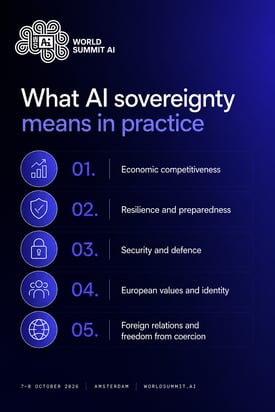 is too vague to be a strategy. Moës defines AI sovereignty as the ability to remain self-determined: to govern how AI is built, deployed and used according to European values and priorities, “without being pressured or subordinate to outside actors.”
That means balancing five connected priorities.
- Economic competitiveness
- Resilience and preparedness
- Security and defence
- European values and identity
- Foreign relations and freedom from coercion
The distinction matters because these priorities can conflict. “You’re going to take actions that will actually help for economic competitiveness, but it will then reduce your resilience or it will reduce your security,” Moës says. Treat sovereignty as a single score to maximise and organisations will optimise the wrong thing.
Why deregulation can weaken Europe’s AI position
.png?width=290&height=363&name=Nick%20Mo%C3%ABS%20(1).png) Moës’ sharpest warning is against equating competitiveness with deregulation. “One common mistake when defining sovereignty is to focus almost exclusively on economic competitiveness, and even worse, to focus economic competitiveness exclusively on deregulation.”
Moës’ sharpest warning is against equating competitiveness with deregulation. “One common mistake when defining sovereignty is to focus almost exclusively on economic competitiveness, and even worse, to focus economic competitiveness exclusively on deregulation.”
Removing constraints on powerful foreign suppliers may look pro-innovation, but it can reduce Europe’s ability to set conditions in its own market while leaving European challengers exposed to incumbents with deeper capital, distribution and infrastructure. As Moës puts it: “Sovereignty in AI is not building everything at home. It’s really about keeping the ability to set our own terms.”
That is particularly important because power is concentrated throughout the AI stack. The leading frontier models are predominantly American or Chinese. Training chips are heavily concentrated. And the cloud layer that runs enterprise workloads is still led by US hyperscalers.
Europe has capable companies, including Mistral at the model layer and a growing field of cloud and infrastructure providers. But capability alone is not enough. The strategic test is whether organisations can access sufficient compute, distribution and operational capacity without relying on a single foreign provider.
How foreign AI dependency disrupts business continuity
This is not an abstract geopolitical concern. It reaches day-to-day business continuity.
That dependency is already playing out. DeepL moved some processing to AWS in May 2026 because no European provider could match its global reach. This was not a choice to abandon European infrastructure; it showed that a European alternative at the required scale did not exist. Analysis of the DeepL AWS change
The same risk applies to any organisation that builds core workflows around a single cloud or frontier-model provider. “Imagine a vendor or a foreign government that just changes the terms, the price, or just cuts access to the model,” Moës says. The result directly affects competitiveness and business continuity: customers see the service interruption or performance downgrade, not the supplier’s rationale.
The exposure extends beyond commercial applications. AI is increasingly embedded in public services, education, healthcare, emergency response, security and critical infrastructure. When those systems operate on infrastructure or models outside European control, the question is no longer simply whether a tool is effective. It is whether a service can be maintained when the political or commercial environment changes.
Why frontier AI creates a new kind of strategic dependency
Europe has lived through earlier technology cycles dominated by US platforms. Moës argues that frontier AI is different because it is not merely infrastructure people use; it is technology that “acts and decides.”
Those systems can encode the assumptions and priorities of their developers into outcomes: what information people see, which candidates are shortlisted, how a risk is assessed or which action is recommended. As models become more capable, the impact reaches labour markets, economic competitiveness, scientific research, cybersecurity and defence.
That makes AI sovereignty both a market issue and a values issue. It is not an argument for isolation. It is an argument for retaining the capacity to reject terms that are incompatible with Europe’s interests.
The sovereignty playbook: build leverage, not autarky
Moës does not argue that Europe must reproduce Silicon Valley at every layer. He argues for focused investments that create negotiating power and credible alternatives.
First, Europe should continue developing models and compute capacity close enough to the frontier that it retains technical competence, local options and the ability to preserve critical capabilities. That means more than headline announcements: it requires dependable data centres, access to energy, skilled teams and a market that adopts what European providers build.
Second, Europe should build partnerships with other middle powers. The goal is not to abandon resilience or values for access. It is to make exclusion costly for suppliers and governments that want to sell into the European market. Moës calls this “an international network with an EU hub”: not autarky, but optionality.
This is why alliances and interoperable infrastructure matter. Optionality is stronger when it is shared: a network of partners, providers and standards can give Europe more leverage than any one country or company can achieve alone.
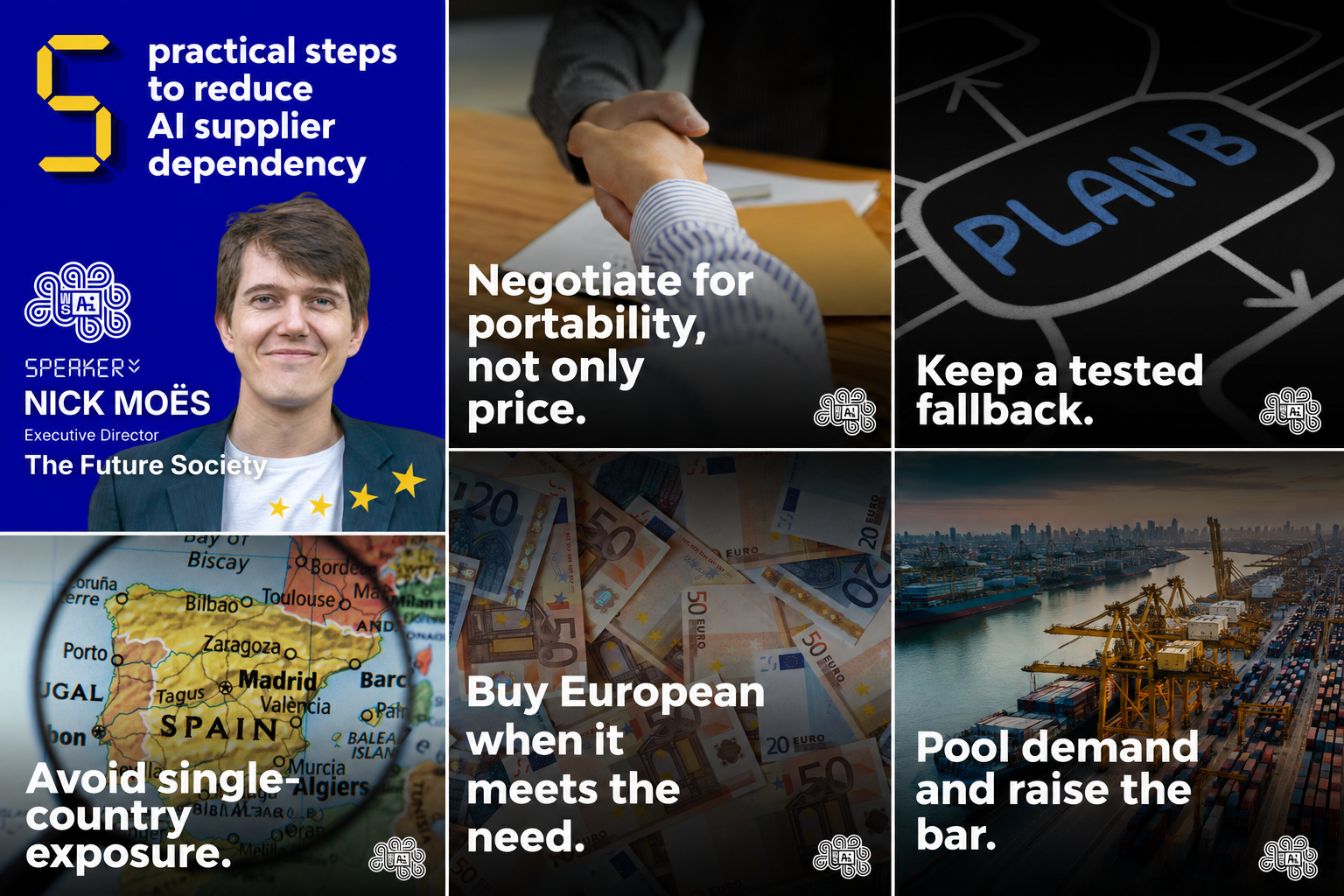
Five practical steps to reduce AI supplier dependency
AI sovereignty is not only a policy agenda. Every European organisation using AI can improve its own position.
- Negotiate for portability, not only price. Before signing a cloud or model contract, ask what happens if the supplier doubles prices, changes terms or becomes unavailable. “If you can’t answer that, you don’t have a real contract, you have a dependency,” Moës says.
- Keep a tested fallback. Maintain a sanitised, open-weight model or alternative deployment path in the background. It may not match a primary frontier model in every task, but it can maintain essential services during disruption.
- Avoid single-country exposure. Identify several viable model providers across multiple jurisdictions. The exact mix will differ by use case, but the principle is simple: no one government decision should be able to halt every critical workflow.
- Buy European when it meets the need. European options are often less visible than US products because they have less marketing reach. Make them part of procurement, pilots and vendor evaluations—not an afterthought. This includes model providers, neoclouds, national cloud providers and specialists in secure deployment.
- Pool demand and raise the bar. A single company has limited power against infrastructure giants. A sector, industry association or consortium can set stronger interoperability, residency, security and exit requirements—and create the customer signal providers need to invest.
These are not anti-American measures. They are ordinary resilience measures applied to a technology that is becoming essential infrastructure.
Where Europe has a credible AI advantage
Europe is unlikely to outspend every frontier lab in the race for the largest general-purpose model. The Stargate project alone illustrates the scale of infrastructure capital now being mobilised in the US.
But competing on every dimension is not the only route to advantage. Europe already holds strategic strengths, most visibly in advanced-chip manufacturing equipment through ASML and the broader semiconductor supply chain. It should protect and build on those positions while investing in areas where its industrial base and regulatory sophistication create a real edge.
Moës’ most compelling comparison is with solar. The first mover in research is not always the winner in industrial adoption. Europe can compete by making AI dependable: safe enough for regulated sectors, robust enough for critical infrastructure and practical enough for enterprise deployment at scale.
That opportunity includes:
- Reliable, auditable AI for finance, healthcare and public services
- Verification tools that demonstrate where and how models ran
- Cybersecurity for systems that still depend on foreign technology
- Deployment, governance and assurance products that make AI fit for high-stakes use
“This is very underfunded at this stage,” Moës says of the work required to make AI safe, reliable and genuinely B2B-ready. As AI shifts from experimentation into business-critical operations, trust, verification and reliability become commercial differentiators.
Three tests for real AI sovereignty
A sovereignty announcement is not a sovereignty strategy. Moës offers three practical tests.
- Map dependencies, broadly and deeply. Look beyond the model provider to cloud infrastructure, data processors, contractors, hardware, cybersecurity tools and the open-source projects that sit beneath the stack. His gut check is memorable: “If you start wondering who is developing your coffee machine’s software update, you probably are broad enough.”
- Build alternatives before they are needed. A contingency plan that has never been tested is not an alternative. Model-switching paths, backup providers and data-portability procedures should be operational, not theoretical.
- Review continuously. The AI landscape changes too quickly for a once-a-year audit. Moës’ rule of thumb is to revisit contingency plans every two to three months, and cybersecurity more frequently still.

Europe is not “behind”: the strategic mindset shift leaders need
The idea that Europe is simply “behind” can become an excuse for inaction: a reason to abandon standards, overlook European suppliers or wait for someone else to build the answer.
Moës argues for a different framing. “This ‘Europe is behind’ mindset is mostly mistaken,” he says. Europe has assets: world-class research, deep industrial expertise, strategic supply-chain positions, a large market and a strong foundation in rights, safety and governance. Its task is to turn those assets into products, infrastructure and purchasing decisions.
He frames the advantage simply: “In order to go fast forever on an uncertain road, you really need to get good brakes.” Europe’s opportunity is to make that foundation commercially valuable rather than treating it as a constraint.
The question is not whether Europe can copy Silicon Valley. It is whether European leaders will build the capacity to make choices on their own terms.
Nick Moës will bring this conversation to World Summit AI in Amsterdam on 7–8 October 2026, as the event marks its tenth anniversary.
InspiredMinds! Community Hub
Inside the InspiredMinds! Community Hub, you’ll find deeper insights, expert perspectives, and practical discussions from the people building and deploying AI across Europe and beyond.

Join our regular LinkedIn newsletter - Global AI Dispatch!
World Summit AI global Summit series
5 – 9 October 2026
Amsterdam, Netherlands
World Summit AI Qatar
World Summit AI Canada
World Summit AI USA