.png?width=259&name=WSAI%20Amsterdam%20Orange%20no%20dates%202000x300%20(1).png)
.png?width=263&name=IM_Mothership_assets_LOGO_MINT%20(2).png)


In April 2026, Uber's engineering leadership discovered that a five-thousand-person team had burned through the company's entire annual AI budget in four months. Per-engineer token costs were running $500 to $2,000 a month, usage had doubled in eight weeks, and the company's COO admitted the surge in spend wasn't translating into proportionally better products (Forbes, Reuters). Uber was not an outlier. The FinOps Foundation's 2026 State of FinOps report found that 73% of enterprises exceeded their original AI cost projections this year, even as the price of a single token kept falling (TechCrunch).
That paradox, cheaper tokens and bigger bills, is exactly the terrain Meryem Arik has spent the last several years mapping. Meryem is Co-founder and CEO of Doubleword, a London-based inference platform that helps enterprises self-host open source and custom AI models (Doubleword), and she was recently interviewed by our Chief Editor, Fawn Hudgens, to talk through what she calls the "hot open weight summer": a moment when cost pressure and a jolt of geopolitical risk are forcing enterprise leaders to rethink how they buy intelligence, not just which model they buy.
How AI subscriptions hide the real cost of inference
The first disconnect Meryem flags is a quiet one. Most enterprises adopted generative AI through bundled subscriptions, tools like Claude Code, priced simply and predictably per seat. That simplicity was hiding the real economics underneath.
"When they move from these bundled subscriptions to the API costs, they are realizing that the usage they have of these AI applications is incredibly expensive," Meryem says. "The bundled subscription cost was actually hiding a lot of the actual genuine AI cost that was going on underneath the hood."
That gap became impossible to ignore once usage-based pricing took over. Enterprise token prices actually fell 67% year-over-year, from $18.40 to $6.07 per million tokens between Q1 2025 and Q1 2026, according to an analysis of 2.4 billion enterprise API calls, yet the average enterprise AI budget nearly tripled over the same window, from roughly $1.2 million a year in 2024 to about $7 million in 2026 (Open Source For You). Cheaper AI and bigger bills are not a contradiction. They are the same story: falling unit prices simply invited far more usage than any 2025 budget model accounted for.
Meryem's second correction is just as blunt. Leaders comparing models on headline token price are asking the wrong question. "The thing that matters is not the token cost. The thing that matters is what was the cost per task," she says, because a cheaper model that needs three times the tokens to solve a problem is not actually the cheaper option.

How the Anthropic export ban proved you're renting, not owning, your AI
Here is where the conversation moves from budgeting hygiene to something more structural. Meryem points to a development from six weeks before the interview: US export controls placed on a leading closed model, which she frames as the moment enterprises realised "you can have an API just turned off out of nowhere and you don't really own it. You're really renting your intelligence rather than owning your intelligence."
That is not a hypothetical. On 12 June 2026, the US Commerce Department sent Anthropic an unpublished letter requiring export licences before its newest frontier models, Fable 5 and Mythos 5, could be made available to any foreign person worldwide, days after their release. The order relied on the Export Control Reform Act and the Export Administration Regulations' military-intelligence end-use rules, and it never appeared in the Federal Register. For roughly three weeks, both models were effectively unavailable outside the US; broader access to Fable 5 only returned on 1 July with added safeguards, while Mythos 5 stayed restricted to approved US institutions (Sheppard Mullin). It happened through a letter, not a rule, with no warning and no public hearing.
For any enterprise that had built a product around that API, the message was unambiguous: proprietary model access is a conditional, revocable arrangement, not an owned asset. That single event has done more to accelerate enterprise interest in open weight models than any pricing spreadsheet could. It is also why the share of enterprise token volume running on open source and open weight models jumped from 11% to 38% in a single year (Open Source For You).
Why self-hosting open source AI models isn't cheap anymore
 It would be easy to hear all this and conclude that self-hosting is the obvious answer. Meryem is careful to push back on that instinct. Self-hosting AI is a fundamentally different proposition from self-hosting a decade ago, because compute, not people, is now the dominant cost.
"If I want to run the latest Kimi model as an enterprise and self-host that as an enterprise, the minimum cost I'm going to have to pay is around 70 to 100 grand every single month," she says, "and that's irrespective of how many users. That's the minimum cost to get one user live." (Moonshot AI's Kimi K3, a 2.8-trillion-parameter open weight model, launched on 16 July 2026, with full weights following on 27 July, the release Meryem was referring to.)
That is precisely why multi-tenant platforms, whether specialist inference providers or hyperscaler services, have become the default even for regulated industries: they spread that six-figure monthly floor across thousands of customers instead of one, rather than making a single company absorb it alone. In Meryem's framing, self-hosting only clearly wins in two situations: when a workload is large and predictable enough to saturate a dedicated GPU cluster, or when strong product-market fit lets a team downgrade to a smaller, specialised model that needs less hardware. Everything in between is usually cheaper to buy as a service.
Three levers that actually cut inference costs
Asked what a CIO with limited attention should prioritise over the next 24 months, Meryem was specific rather than aspirational:
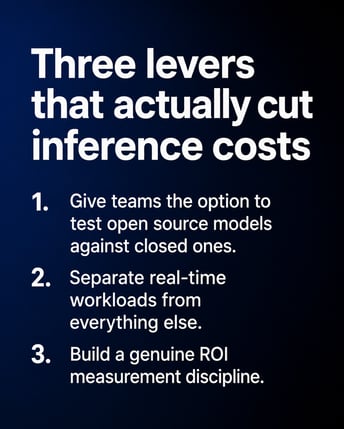
- Give teams the option to test open source models against closed ones. She estimates roughly an 8x cost difference for comparable intelligence, because open model providers only charge for compute and serving, not for clawing back in training. The quality gap narrowed to what she describes as a three-month lag between open and closed releases.
- Separate real-time workloads from everything else. Chatbots and other latency-sensitive use cases force providers to over-provision compute for traffic spikes, which gets priced into the token. Doubleword's own batched, asynchronous APIs run 80–90% cheaper than its real-time equivalents for work that can tolerate a delay.
- Build a genuine ROI measurement discipline. Meryem is candid that this is the hardest of the three: cost reduction is easy to quantify, but most teams don't actually cut headcount when AI makes people more productive, they simply produce more. Revenue upside from AI is even harder to isolate.
Layered together, an 8x saving from open models plus an 80–90% saving on non-real-time traffic compounds fast, but only for organisations disciplined enough to route work deliberately instead of defaulting every request to the most expensive, most latency-sensitive path.
How single-provider lock-in inflates your AI model costs
Most enterprises are not choosing one model. They are accumulating several, open and closed, large and small, often per team rather than by design. Meryem's answer to that sprawl is architectural: put a model gateway in the middle of it. It is where cost tracking, routing, and authentication should live, and she recommends an open source gateway specifically so it can be deployed inside a company's own private environment rather than adding another vendor dependency on top of the model dependency already in play.
That advice connects directly back to her opening warning. The biggest trap she sees isn't a bad model choice, it's single-provider lock-in, which she estimates can leave teams paying multiples more than necessary. It comes down to who is footing the training bill: proprietary labs like OpenAI and Anthropic have to claw back the billions they spent training frontier models, while an inference provider serving open models carries none of that debt. "The costs that I charge my customers are the amount it cost me to inference them, plus a tiny bit of margin," Meryem says.
The leadership test for managing AI inference costs
.png?width=259&height=324&name=Meryem%20Arik%20(2).png) Meryem opened the conversation by warning that her answer would likely be different by the time she takes the stage at World Summit AI in October, and given how much moved in the six weeks before this interview alone, that is not a hedge, it is a forecast. What won't change by October is the underlying test she's laid out for leadership teams: know your cost per task, not just your token price; know exactly what you are renting versus what you actually own; and know which of your workloads can tolerate a cheaper, slower path before you assume the expensive one is the only option.
Meryem opened the conversation by warning that her answer would likely be different by the time she takes the stage at World Summit AI in October, and given how much moved in the six weeks before this interview alone, that is not a hedge, it is a forecast. What won't change by October is the underlying test she's laid out for leadership teams: know your cost per task, not just your token price; know exactly what you are renting versus what you actually own; and know which of your workloads can tolerate a cheaper, slower path before you assume the expensive one is the only option.
The organisations getting ahead of this are not the ones chasing the lowest headline price. They are the ones treating inference economics, and inference sovereignty, as a standing leadership question rather than a line item they revisit once a budget blows up.
InspiredMinds! Community Hub
Inside the InspiredMinds! Community Hub, you’ll find deeper insights, expert perspectives, and practical discussions from the people building and deploying AI across Europe and beyond.

Join our regular LinkedIn newsletter - Global AI Dispatch!
World Summit AI global Summit series
5 – 9 October 2026
Amsterdam, Netherlands
World Summit AI Qatar
World Summit AI Canada
World Summit AI USA